Have fun!
Friday, 4 May 2012
HyperRogue bugfix (3.2)
HyperRogue version 3.2 fixes two minor bugs:
The big white X which appears during the final quest should no longer disappear randomly (thanks to ortoslon for reporting this).
Using the anaglyph mode ("distance between eyes") no longer causes the letters to disappear.
Have fun!
Have fun!

Thursday, 3 May 2012
HyperRogue III (version 3.1)
HyperRogue version 3.1 is released!
This version contains many optimizations, which make the animations much smoother. Mostly due to using compiler's optimizations, but also game mechanics and shape drawing routines are optimized.
These optimizations also make an Android port possible.
There are also some bugfixes and minor features ("dead ivy" shows correctly, necromancy bugfix, restarting after finding the Orb of Yendor no longer crashes the game, help fits better on the screen, you can right click the framerate for hints about improving it.
Here are some screenshots from the Android version. As always, have fun!


This version contains many optimizations, which make the animations much smoother. Mostly due to using compiler's optimizations, but also game mechanics and shape drawing routines are optimized.
These optimizations also make an Android port possible.
There are also some bugfixes and minor features ("dead ivy" shows correctly, necromancy bugfix, restarting after finding the Orb of Yendor no longer crashes the game, help fits better on the screen, you can right click the framerate for hints about improving it.
Here are some screenshots from the Android version. As always, have fun!
Monday, 23 April 2012
HyperRogue III
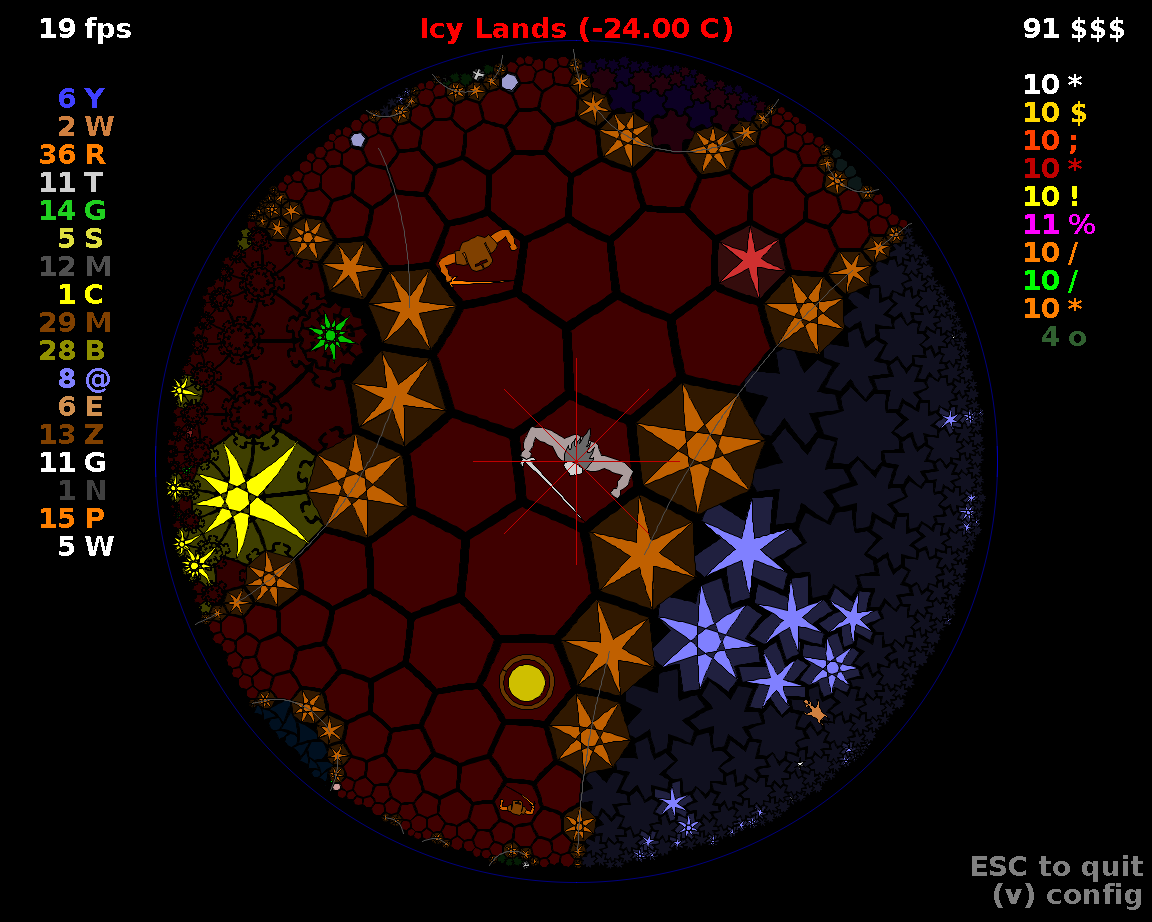
Crossroads
|
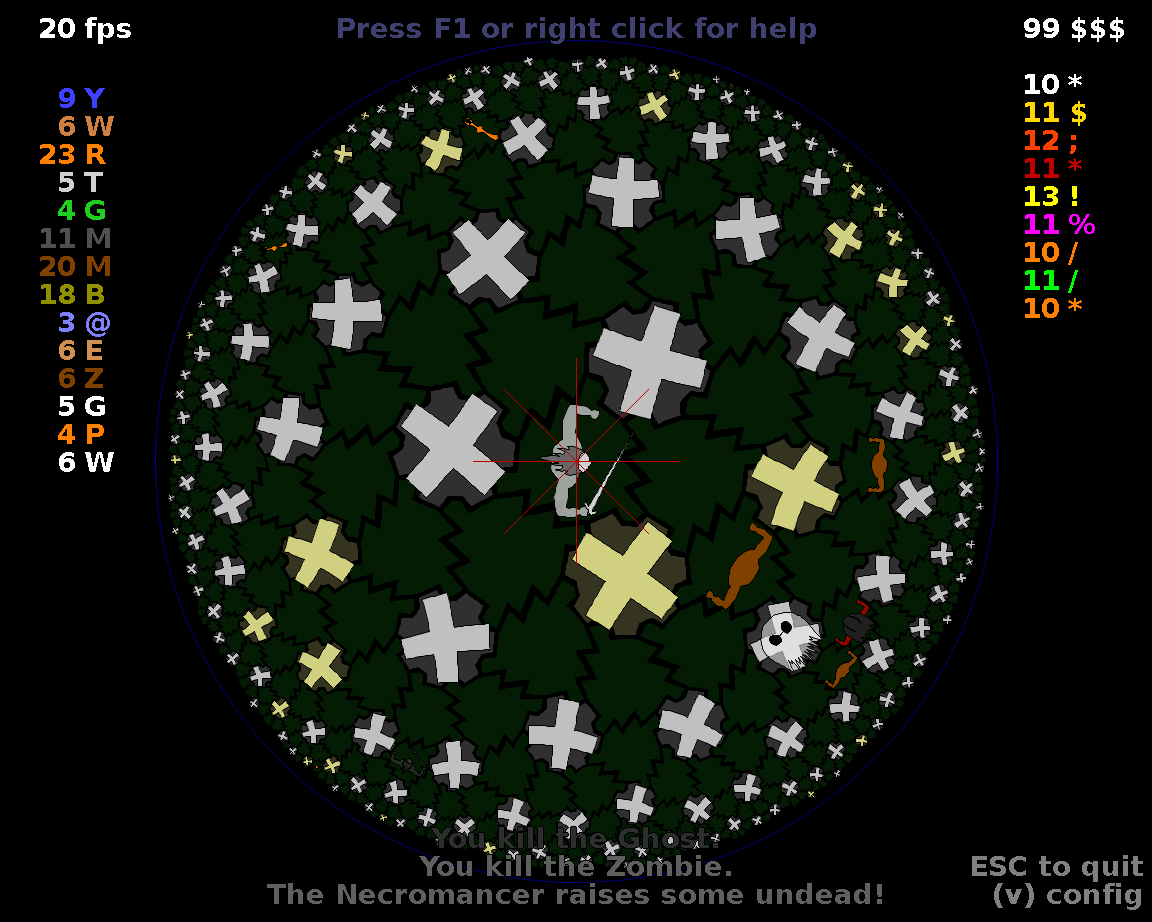
Necromancers of Graveyard
|
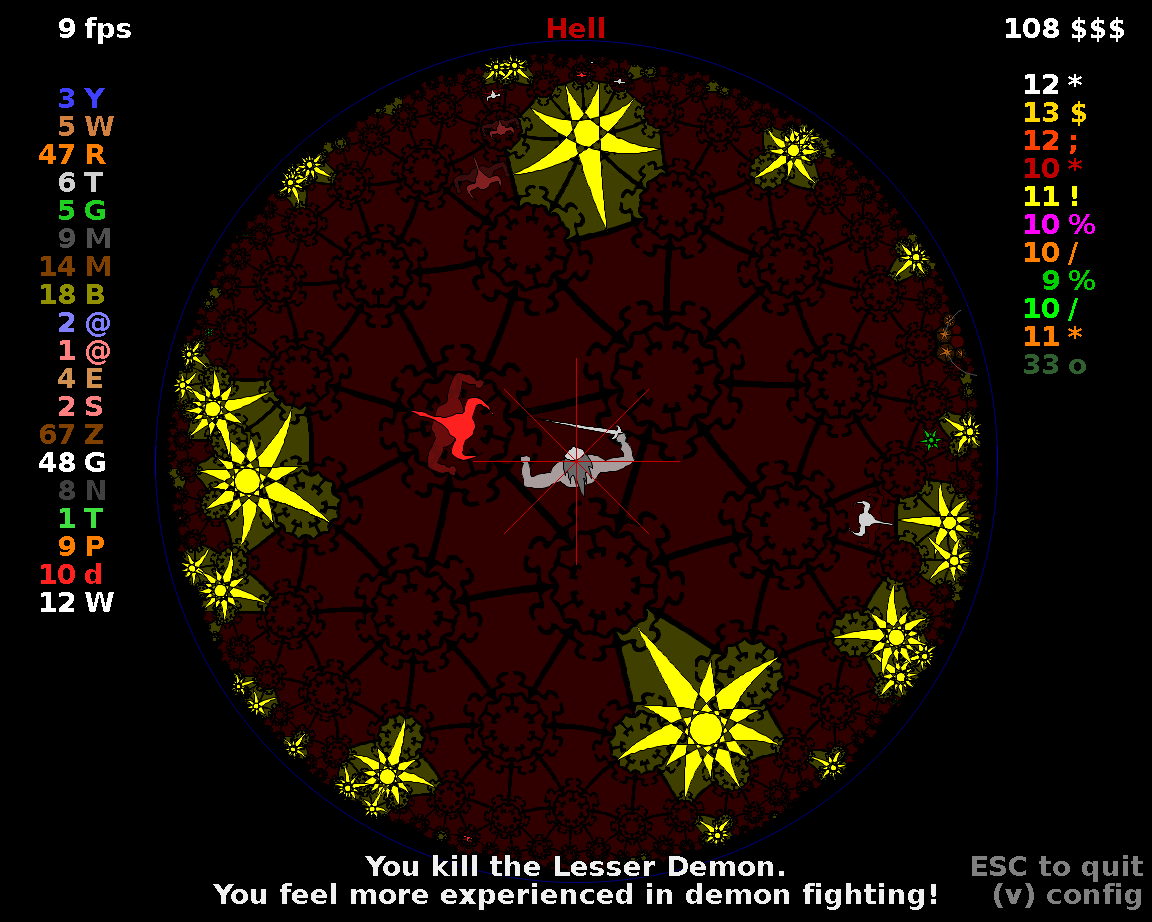
Demons of Hell
|
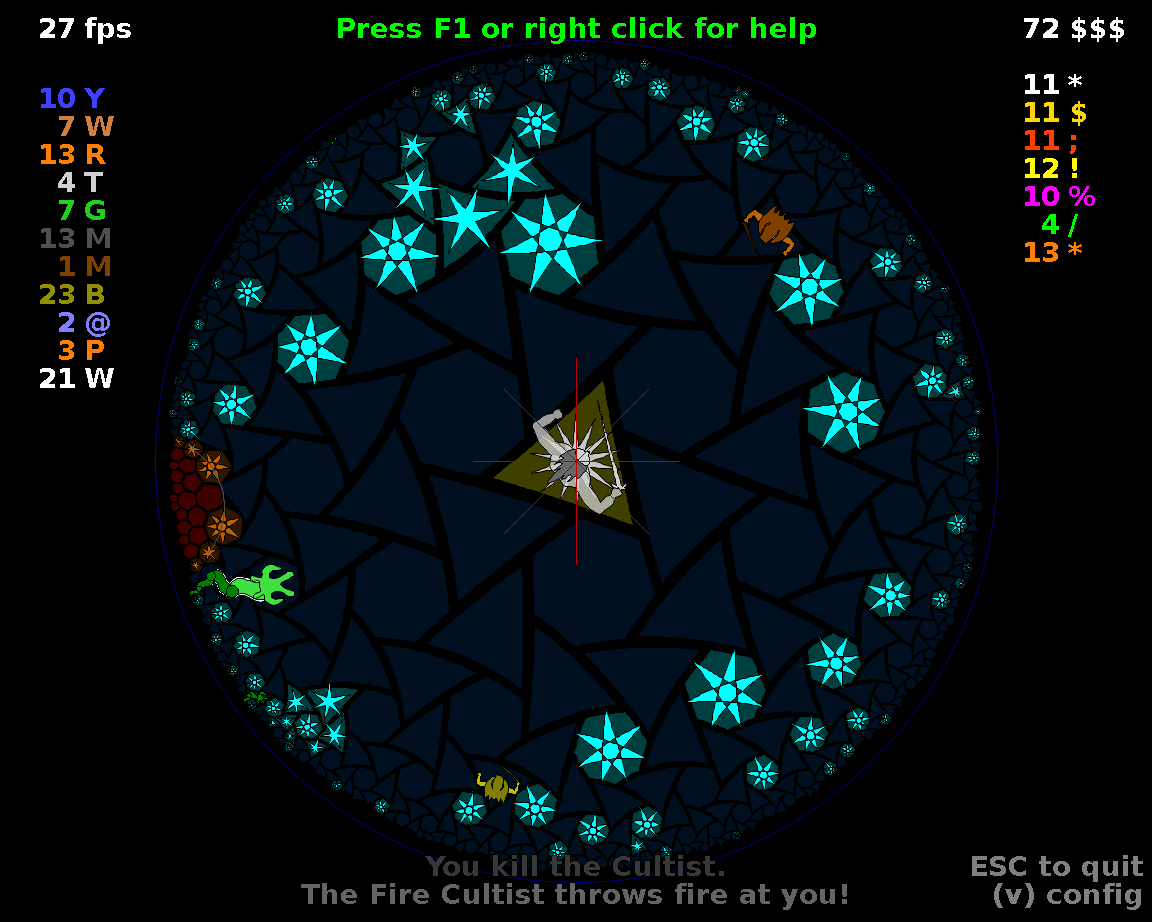
Cultists of Cthulhu
|
The most visible change is the addition of graphics. This will hopefully make it more playable for people who are not hardcore roguelike fans. Of course, the ASCII display from the previous versions is still available (press "v" for configuration, then "w" and "m"), it also seems to run more smoothly on some of the older machines.
The floor graphics are slightly based on the works of M. C. Escher, one of the few artists who did use hyperbolic geometry in the past. You need to press 'v' to activate the new floors, as they are more confusing and slower to draw.
Also, four new lands have been added (the Land of Eternal Motion, Graveyard, R'Lyeh, and Hell).
Another big thing is that you now have a quest, instead of just aiming for high scores. You are no longer able to immediately enter all the lands, some of them will appear only if you have met certain requirements (most of them related to score). Ultimately, you will be able to reach Hell, and find the Orb of Yendor. Of course you can still aim for high scores, too.
This makes the challenges in Hell (which I find quite interesting) a reward for the most careful players, while HyperRogue II allowed everyone to see everything. It has good and bad points, but I think it is worth it to motivate the players.
And some balance improvements. Overall, I think this is enough changes to change the name again, to HyperRogue III (Hyperbolic Rogue was the preliminary concept work, and HyperRogue II was the 7DRL challenge version).
Have fun, and good luck in your quest for the Orb of Yendor!
Friday, 6 April 2012
Necklace of the Eye version 5.1
The 7DRL challenge has created a wave of good roguelikes, some of them using the newest libtcod version. Drakefire Chasm is very good, but I could not get it into fullscreen on my Linux machine. So I have tested it with NotEye, and found some bugs (not very surprising, since Brogue was the only libtcod roguelike I have tested it on in the past). NotEye version 5.1 fixes these bugs, and adds some minor new features. I can play Drakefire Chasm on Linux in fullscreen now. :)
Drakefire Chasm and Top Dog via NotEye
Unfortunately Sword in the Hand is not supported, since it uses libtcod 1.5.0. Porta Lucis uses a Visual Studio version of libtcod (I am not sure which version) and I cannot try it. Download NotEye 5.1 here!
- includes a config for Drakefire Chasm and Top Dog
- libtcod fix: TCOD_sys_wait_for_keypress now stops waiting on a NotEye keypress too (this one broke both games above)
- streaming fix (including libtcod): zipped stream is now flushed correctly (this bug made Top Dog halt in some circumstances)
- NotEye no longer needs to be able to find the font file when running a libtcod game (it uses its own font instead)
- Vapors of Insanity tiles are included (and some of them are used by Drakefire Chasm)
- Some new fonts added to the selection: Fantasy 16x16, double-sized 8x8 terminal font (for square-shaped games such as Top Dog)
- grass icon in Brogue is raised
- a dev mode added to the libtcod.noe config, which can be used to get the RGB colors and positions on mouseover
- an option to make screenshots with F4 (useful for animations)
- the website has been redesigned to provide a more detailed information about each supported game

Breathing fire |

FPP |

Dialog |

ISO |

a Priest casting a spell, in 3D |

ISO |
Unfortunately Sword in the Hand is not supported, since it uses libtcod 1.5.0. Porta Lucis uses a Visual Studio version of libtcod (I am not sure which version) and I cannot try it. Download NotEye 5.1 here!
Sunday, 1 April 2012
HyperRogue II in news and videos
Recently there have been some news and videos featuring HyperRogue.
It has been mentioned on the Roguelike Radio in its 7DRL 2012 episode. I think it was Jeff Lait who has noticed that, due to the special structure of the map, monsters chasing you will usually form a line. Indeed, this is a result of the hyperbolic nature of the world: you cannot have several monsters moving on parallel lines, unless they are on the same line. And I thought that it was just a result of simplifications in my pathfinding algorithm. ;) A nice observation, thanks!
Geek New Wave has a review of HyperRogue II (as well as of the original Hyperbolic Rogue), and also an interview with me. Have fun reading it :)
There are also some guys who post videos featuring recent 7DRLs. Game Hunter is blind running all of them, and here is how he sees HyperRogue:
I see that he has missed some important things in his blind run. You can mouse over the map, which explains what is what. This is most useful while having mirror images, as you can also see their cursors, which shows you where they would go. He did not visit the Desert, only touched the Living Caves, and ignored the Jungle (I think he confused it with Living Caves and thought he had already been there). Quite unfortunate, I think these areas are more fun than Alchemists Lab and the Land of Mirrors that he visited. Of course he did not see most of the magical orbs, but it is understandable in such a short try.
Also, dewaldo is posting videos of 7DRLs after becoming more familiar with them:
This video explains more about the game. I think it is a bit funny how he thought that he cannot do any move, while he actually had one (he could press '.' to wait for the slime beasts to move next to him). The game always informs you when you can no longer move.
Thanks to all the authors, and to you for reading this. :)
Geek New Wave has a review of HyperRogue II (as well as of the original Hyperbolic Rogue), and also an interview with me. Have fun reading it :)
There are also some guys who post videos featuring recent 7DRLs. Game Hunter is blind running all of them, and here is how he sees HyperRogue:
Also, dewaldo is posting videos of 7DRLs after becoming more familiar with them:
Thanks to all the authors, and to you for reading this. :)
Sunday, 18 March 2012
hyperbolic geometry in HyperRogue
NOTE: This post was originally published on March 18, 2012. It has been updated many times:
2015 to reflect some new findings,
Sep 2016 to include the numerous new hyperbolic features,
Oct 2018 with even more features and links.
The main goal of the HyperRogue project is to see how hyperbolic geometry can be used to achieve great game design (and it succeeds in this goal -- see e.g. this review on Rock Paper Shotgun). (This is not the only goal, though -- HyperRogue is probably the most feature-rich engine for non-Euclidean geometry, that can be used for a plethora of visualization, research, and educational purposes; see RogueViz.) The purpose of this article is to explain what's the deal. It is intended for mathematicians interested in hyperbolic geometry who would like a summary of HyperRogue, and for roguelike players who would like to know what hyperbolic geometry is -- some of them think that HyperRogue takes place on a 3D sphere, or that you will return to the same location if you move in a particular direction for a long time, which is not accurate at all, so I explain it here in more detail.
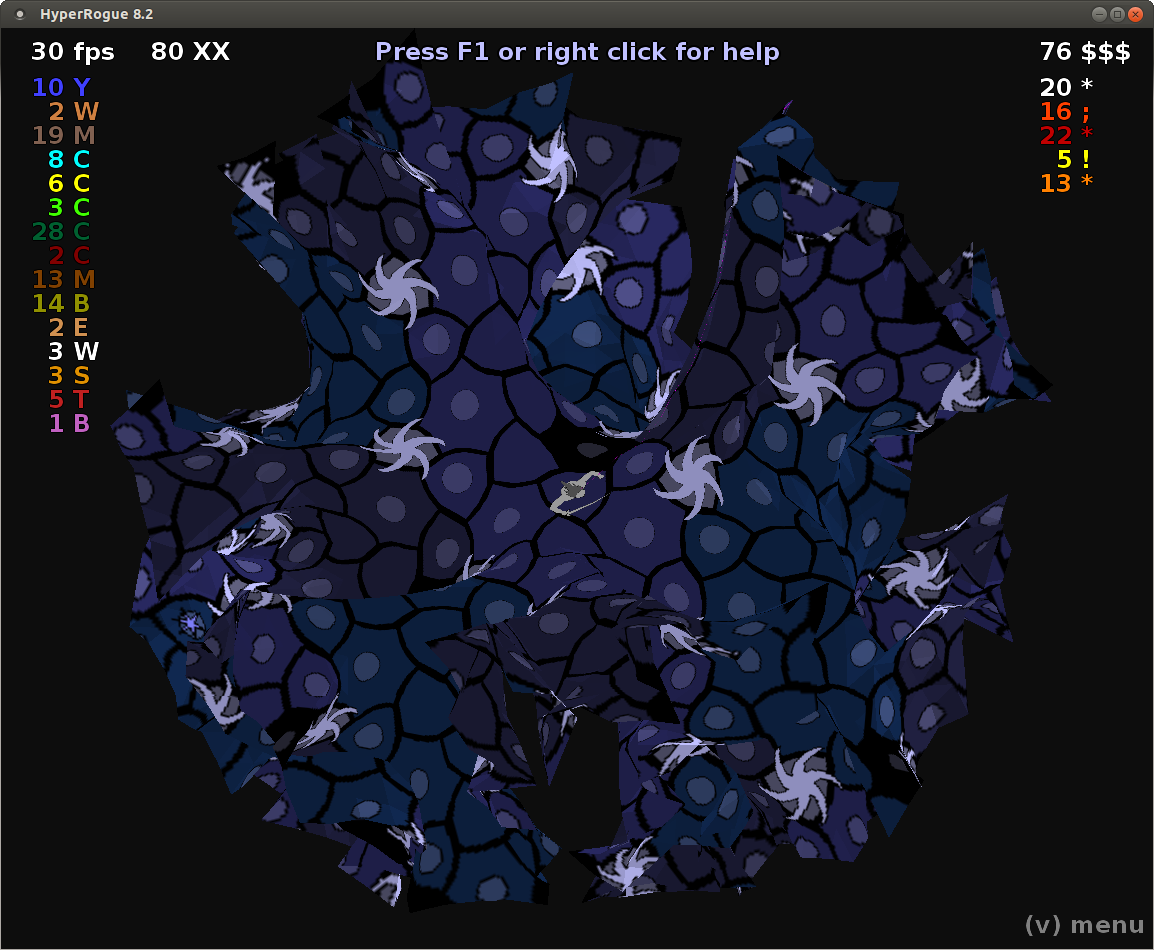
HyperRogue is a roguelike computer game. Roguelikes are a genre of computer games that have evolved separately from the mainstream -- even though they are commonly viewed as a subgenre of RPGs, they are in many senses closer to board games, like Chess where you have just one piece and the "chessboard" is randomly generated by the computer, than to other computer games. (Recently the elements of roguelikes, such as procedural generation and the challenge of permadeath, are added to more and more computer games which do not really have much in common with true roguelikes, causing even more confusion.) In case of HyperRogue, the "chessboard" is an infinite hyperbolic plane. You can read more about it on Wikipedia. This is not a sphere, but rather a hyperboloid (but also not in a normal space). The 3D object you see when you activate the "eye distance" option is this hyperboloid.
Hyperbolic geometry seems to be underused in art. M.C. Escher has been using it in some of his work (like Circle Limit). I have seen Maze, Pool, and Sudoku on a hyperbolic plane, but here the map is looped, and thus IMO less interesting than the real infinite world of HyperRogue. The original concept of Hyperbolic Rogue got quite popular despite being an extremely simple game, so I think this is a great area to explore.
Normally the game presents the world in the so called Poincaré disc model (also used by the art mentioned above). The closer you are to the edge of the disc, the bigger distances are (five pixels close to the edge is a much bigger distance than five pixels in the center). On the Euclidean plane, the boundary of a circle of radius r is linear in r. On the hyperbolic plane it is exponential. This means that it is very hard to return to a place where you have already been in HyperRogue. You would have to return almost the same way.
Triangles in hyperbolic geometry have angles which sum to less than 180 degrees. For example, if you take two hexagons and one heptagons next to each other on the HyperRogue map, and construct a triangle with vertices in centers of these cells, the sum is (360/6) + (360/6) + (360/7) = 171.4 degrees, so there is a "defect" of 60/7 = 8.6 degrees. The defect is proportional to the area of the triangle. (Similar thing happens on a sphere: a triangle with a vertex on a pole and two on the equator has 90+90+90 = 180+90 degrees, which is π/2 more than 180 degrees, and the total area of the sphere is 4π, which corresponds to eight of our triangles.) The visible in-game effect of this is that if you go from A to B, from B to C and from C back to A, the screen will (probably) appear rotated, making it easier to get lost.
This is the map structure I have found most suitable for a roguelike (or other similar grid-based game). Three hexagons would sum up to 180 degrees and we would get a plane. Three heptagons in each corner would be possible, but they would be too big (each of them would take the space of one heptagon in HyperRogue plus 1/3 of each hexagon surrounding it).
Now how does this relate to the actual gameplay? As already mentioned, an important result of using the hyperbolic plane is that you almost never get into a place where you have been before. Some of the areas make other aspects of the hyperbolic geometry important, and some are just for fun.

Land of Eternal Motion::When you are running away from monsters on a straight line in the Land of Eternal Motion, monsters cannot follow you on the same line, they have to use an equidistant curve instead. Since these curves are longer in hyperbolic geometry, it is quite easy to run away.

Hunting Grounds::
In lands other than Land of Eternal Motion, when you are running away from a monster, it will have to chase you on exactly the same path as you, and if there are several monsters, they will have to make a queue. In most roguelikes, the basic strategy is that, when attacked by a group of monsters, you should run into a corridor, and fight them one by one. In HyperRogue, this effect can be achieved in an empty space.
At low treasure counts, Hunting Grounds pits you against several dogs. Use the effect above to queue them up -- that would not be possible in an Euclidean hex grid (where they would pursue you forever), or in a spherical tesselation (where three dogs would eventually get you).
At higher treasure counts you also get ambushed by dogs, apparently from "all" directions. However, in the hyperbolic plane, there are more directions than it appears, so you can still escape!

Crossroads (and walls in general): walls separating different areas are straight lines, and they do not cross. You cannot have that many non-crossing straight lines in a Euclidean world.

Land of Mirrors: mirages would be very nice to play in a Euclidean world (see DROD's mimics for something very similar), my point here was to check how this would work in a hyperbolic plane. The result seems to be that they are mostly annoying (they are supposed to stay parallel to you, but parallel lines diverge too quickly).
In later versions, the Land of Mirrors has been replaced with Hall of Mirrors -- this adds mirrored walls that the Mimics can reflect off; this makes the land interesting in hyperbolic plane too :)

Living Caves: the cave has a tree-like structure: you go into a tunnel, sometimes you find forks, and you can be almost sure that both of the new tunnels do not end, and in fact, they quickly fork again. And loops are extremely unlikely. In an Euclidean world, this would not work. It would be at least a bit different.

Alchemist's Lab: a bit like the Living Caves, the hyperbolic nature of the map means that you can usually get as far as you want in roughly any direction, no matter whether what color you are on. From the game Hex we know that, in Euclidean geometry, if there is a red connection between top and bottom the screen, there is no blue connection between left and right. While this is still true in hyperbolic geometry, it does not feel like that, because we have many more directions there. This has ties to the percolation theory.

Icy Lands: that's a minor difference, but heat disperses more quickly here than it would on a Euclidean plane (actually the model in the original tech demo was a bit wrong).

Camelot: In Camelot, you have to find the Holy Grail, which is in the center of the Round Table. The Round Table is a circle of radius 28. The number of cells in a circle of radius r is roughly 3 to the power of r/2; in particular, there are 31659398 floor tiles inside the table, and 22860754 tiles of the table. Thus, when you start on the table and start moving in a completely random direction, you will run straight into the Holy Grail with probability only 1/31659398 -- if you choose the direction based on the shape of the table, the probability is of course higher, but still, after a small number of steps you will usually end up back at the Table. You need to invent some strategy to precisely take you to the center.

The Hive is an attempt at depicting how a war in hyperbolic plane would look. In our world, an army has a first long row of soldiers, then the second row, and so on. This way, the army moves quickly, and many soldiers can fight in parallel. However, this does not work in the world of HyperRogue: one column of soldiers may move on the straight line between points A and B is the shortest route, but if we have another column, it will have to move on an equidistant curve, which will be much longer. Therefore, if the army wants to move quickly, it will have just a small number of columns.

Horocycles: In the Hive and Camelot, you could see how big circles look in the hyperbolic plane. While in the Euclidean world, big circles resemble straight lines more and more, the situation in the world of HyperRogue is different -- they always look curved. If you are standing on a circle, it is easy to tell that this is not a straight line -- but locally, a fragment of a circle of radius, say, 10 tiles will look almost exactly the same as a fragment of a circle of radius, say, 100 tiles. A horocycle is what we get in the limit -- something like a circle of infinite radius. The Temple of Cthulhu is an infinite sequence of horocycles, where you have to go deeper and deeper to get more points, and Whirlpool is a horocycle which draws you toward its infinitely distant center.

Caribbean is unmarked, and shows that, just as in Camelot, it may be hard to find the direction towards the center of the horocycle -- you have to use compasses to lead you there.

A Great Wall is a straight line, and the coast is an equidistant curve at some distance from this great wall (the distance changes with the tides). As you can see, it is hard to tell the difference between a large circle, horocycle, or a distant equidistant -- so if you are in the Ocean, it is not immediate to tell whether the waves you see are because of the nearby coast, or because of the nearby Whirlpool. See this article by Fulgur14 to read more about circles, horocycles, and equidistant curves.

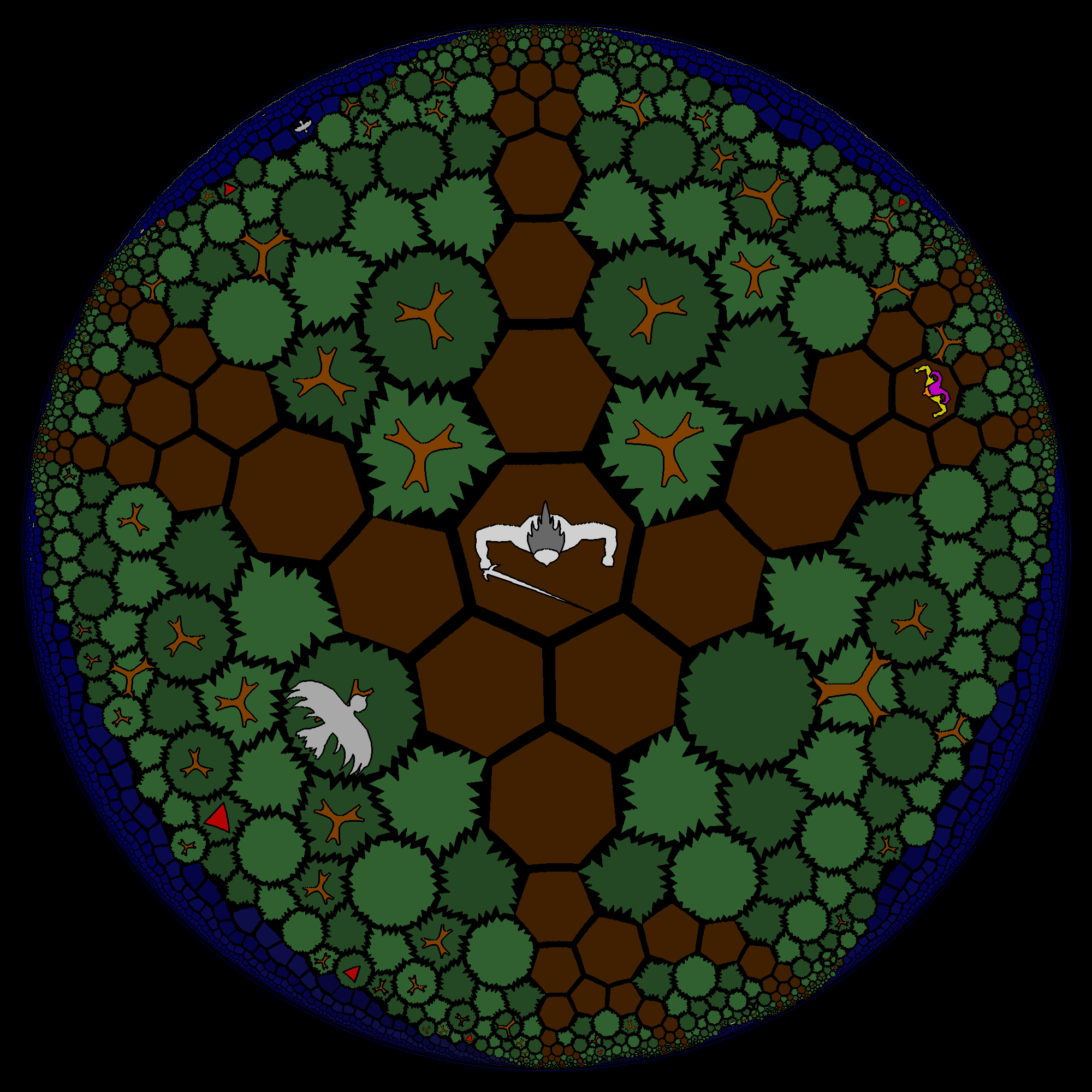
The Haunted Woods is a land from where there is just one exit -- it is bounded by a single curve. For further confusion, this curve may look like a circle or horocycle, but it is not -- it is an equidistant curve -- while moving randomly inside a horocycle quickly gets you to its edge, in the Haunted Woods, if you cross the straight line and go randomly on the other side, you will likely be lost forever in the Haunted Woods, as you have to return to the location where you have been before, and this is virtually impossible, due to the exponential growth. The Yendor Quest is based on the same principle -- you have to go 100 steps to find the Key, then return. There is a marker which shows your way to the Key, but you have to return on your own, which is virtually impossible based only on luck or memory.

In the Princess Challenge, a mouse asks you to reach the Princess, locked somewhere in the Palace. She is 100 steps away, so you would not find here without help -- luckily, the mouse will lead you. The screenshot above shots the cell where the Princess is locked -- you have to press the green button in bottom left to open the doors; when you first see the princess, you are typically on the other side, and have to go around all these closed doors. This exhibits interesting properties of hyperbolic mazes -- there are obstacles on the way, and sometimes you will have to do significant detours to go around them, but if you know what you are doing, you will eventually reach the Princess with probability of (almost) 1. This is related to branching processes.

The Crossroads III, as well as the Elemental Planes later in the game, show straight lines which cross at straight angles.

The Ivory Tower shows you how gravity could work in the hyperbolic world. Gravity is directed towards a straight line, thus making the horizontal levels into equidistant curves. Interestingly, while in the most of the game it is very hard to return to the location you have been to, in these lands, you simply go with the gravity to exit, and you turn up at almost exactly the same location you started. This is because, as usual, levels grow exponentially: moving 243 cells on the level 20 corresponds to moving just 243/3(20-10)/2 = 1 cell on level 10.

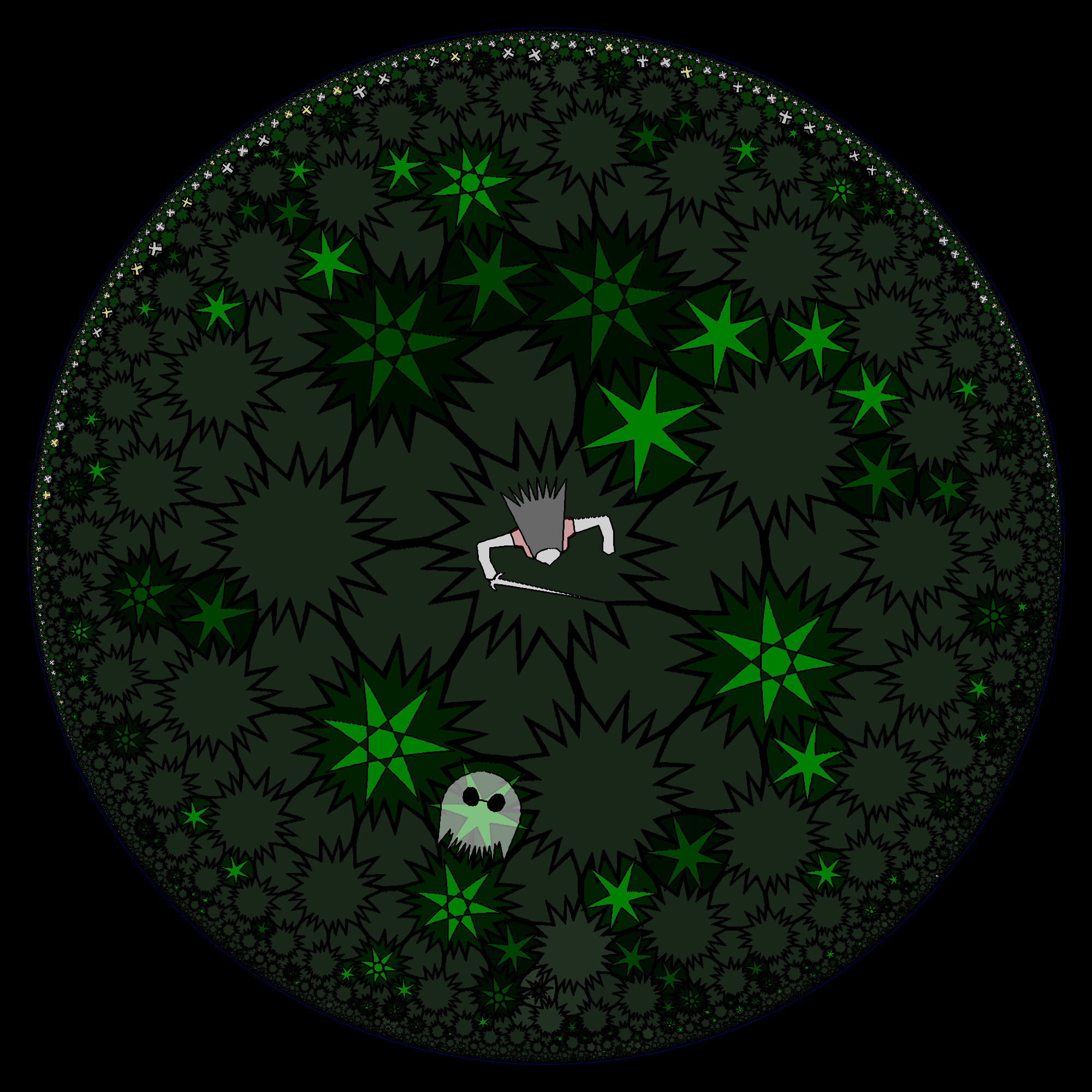
The Yendorian Forest is another land in gravity. We already had straight lines that cross, and that are ultraparallel (diverging). Branches of the same tree in the Yendorian Forest are straight lines that diverge when you go upwards, but get closer and closer when you go towards the base level.

There are regular patterns in Euclidean plane, which generally look like grids. We also have regular patterns in the hyperbolic plane, but they look more like infinite trees. Such regular patterns appear in the Vineyard, Land of Power, Zebra, Windy Plains, Emerald Mine, and Palace. The picture above shows the Vineyard; see the Gallery of Lands for the screenshots of the remaining regular lands.

In the Burial Grounds, you have to fight enemies and excavate treasures, using a magical energy sword. This sword stays at the same relative angle to you when you move. However, after you go in a closed loop, the sword will usually be rotated, because of how angles work in the hyperbolic plane! This land obviously makes no sense in the Euclidean mode.

In Galápagos, each tortoise has 21 binary properties, thus leading to 221 = 2097152 subspecies. Tortoises at the given spot are usually exactly the same, but as you travel, the environmental properties change smoothly, and so do the properties of Tortoises. You have found a (random) baby tortoise, and you have to find a tortoise which exactly matches the baby. This would not be feasible in the Euclidean plane -- even if you exactly knew where the correct tortoise are, you would still have to go 1000 steps to reach it, but since you don't know, you would have to wander blindly. In the hyperbolic plane, the correct tortoise is always actually quite close, because of the exponential growth; furthermore, the simple method of always going towards the direction where more properties agree works. The coloring of tiles in the Galapagos (based on the number of factors which agree), as well as the height function used to generate the Dragon Chasms, is related to a generalization of the Wiener process to the hyperbolic plane domain -- there are similar generalizations to Euclidean plane domains, but for hyperbolic plane this is mathematically much more elegant.

You can also change the geometry in HyperRogue. The first alternate geometry was, of course, the Euclidean mode -- see this old post about it. In 2018 the big part of work on HyperRogue was adding more and more geometries to experiment with. Disable bitruncation for stronger hyperbolic effects; apply the Goldberg-Coxeter construction to weaken them (which may make you lose to dogs in LoEM or Hunting Grounds -- even though the world is globally hyperbolic, there are parts which are flat); play on the sphere; use irregular, or mostly arbitrary Archimedean tilings; and so on. See this article for all the possibilities.

The Poincaré disc model is just one of many possible models ("maps") that can be used to display the hyperbolic plane. HyperRogue also lets the players to play with other models. In the band model, you can see that your route through the game is almost a straight line; in the half-plane model, horocycles are horizontal and branches of Yendorian Forest are (almost) vertical; in the Klein model, straight lines look straight; the Hypersian rug model lets you play on something similar to the hyperbolic crochet, and the paper model creator even lets you to print it. See this article for more details.
The main goal of the HyperRogue project is to see how hyperbolic geometry can be used to achieve great game design (and it succeeds in this goal -- see e.g. this review on Rock Paper Shotgun). (This is not the only goal, though -- HyperRogue is probably the most feature-rich engine for non-Euclidean geometry, that can be used for a plethora of visualization, research, and educational purposes; see RogueViz.) The purpose of this article is to explain what's the deal. It is intended for mathematicians interested in hyperbolic geometry who would like a summary of HyperRogue, and for roguelike players who would like to know what hyperbolic geometry is -- some of them think that HyperRogue takes place on a 3D sphere, or that you will return to the same location if you move in a particular direction for a long time, which is not accurate at all, so I explain it here in more detail.
HyperRogue is a roguelike computer game. Roguelikes are a genre of computer games that have evolved separately from the mainstream -- even though they are commonly viewed as a subgenre of RPGs, they are in many senses closer to board games, like Chess where you have just one piece and the "chessboard" is randomly generated by the computer, than to other computer games. (Recently the elements of roguelikes, such as procedural generation and the challenge of permadeath, are added to more and more computer games which do not really have much in common with true roguelikes, causing even more confusion.) In case of HyperRogue, the "chessboard" is an infinite hyperbolic plane. You can read more about it on Wikipedia. This is not a sphere, but rather a hyperboloid (but also not in a normal space). The 3D object you see when you activate the "eye distance" option is this hyperboloid.
Hyperbolic geometry seems to be underused in art. M.C. Escher has been using it in some of his work (like Circle Limit). I have seen Maze, Pool, and Sudoku on a hyperbolic plane, but here the map is looped, and thus IMO less interesting than the real infinite world of HyperRogue. The original concept of Hyperbolic Rogue got quite popular despite being an extremely simple game, so I think this is a great area to explore.
Normally the game presents the world in the so called Poincaré disc model (also used by the art mentioned above). The closer you are to the edge of the disc, the bigger distances are (five pixels close to the edge is a much bigger distance than five pixels in the center). On the Euclidean plane, the boundary of a circle of radius r is linear in r. On the hyperbolic plane it is exponential. This means that it is very hard to return to a place where you have already been in HyperRogue. You would have to return almost the same way.
Triangles in hyperbolic geometry have angles which sum to less than 180 degrees. For example, if you take two hexagons and one heptagons next to each other on the HyperRogue map, and construct a triangle with vertices in centers of these cells, the sum is (360/6) + (360/6) + (360/7) = 171.4 degrees, so there is a "defect" of 60/7 = 8.6 degrees. The defect is proportional to the area of the triangle. (Similar thing happens on a sphere: a triangle with a vertex on a pole and two on the equator has 90+90+90 = 180+90 degrees, which is π/2 more than 180 degrees, and the total area of the sphere is 4π, which corresponds to eight of our triangles.) The visible in-game effect of this is that if you go from A to B, from B to C and from C back to A, the screen will (probably) appear rotated, making it easier to get lost.
This is the map structure I have found most suitable for a roguelike (or other similar grid-based game). Three hexagons would sum up to 180 degrees and we would get a plane. Three heptagons in each corner would be possible, but they would be too big (each of them would take the space of one heptagon in HyperRogue plus 1/3 of each hexagon surrounding it).
Now how does this relate to the actual gameplay? As already mentioned, an important result of using the hyperbolic plane is that you almost never get into a place where you have been before. Some of the areas make other aspects of the hyperbolic geometry important, and some are just for fun.


At low treasure counts, Hunting Grounds pits you against several dogs. Use the effect above to queue them up -- that would not be possible in an Euclidean hex grid (where they would pursue you forever), or in a spherical tesselation (where three dogs would eventually get you).
At higher treasure counts you also get ambushed by dogs, apparently from "all" directions. However, in the hyperbolic plane, there are more directions than it appears, so you can still escape!


In later versions, the Land of Mirrors has been replaced with Hall of Mirrors -- this adds mirrored walls that the Mimics can reflect off; this makes the land interesting in hyperbolic plane too :)






Friday, 16 March 2012
HyperRogue bugfix
Sorry for those who have found crashes when playing with mouse and mirrors, or Ivy plants not challenging enough. Version 2.1, still in time for the 7DRLC, has the following bugfixes and minor additions:
- The game should no longer crash when moving in certain directions while having mirror images.
- Living Caves now include Seeps and are thus now more challenging.
- You can no longer deactivate an ivy plant by cutting out an active branch next to the root.
- Shield protection from a sandworm is now less weird.
- Slime colors are now named correctly.
- Some sanity checks added just in case.
Subscribe to:
Posts (Atom)